I can't promise that this will be the sane version, but it shall at least be saner. I promise not to go off into a rant about Abraham Lincoln this time, I swear.
In other words, READ THIS ONE, not the other one, unless you want brutal honesty. This is the polite version.
Until Dr. Brewton tells me otherwise, I shall only write about those pieces of literature about which I can find something meaningful to say. So here goes. *deep breath*
Unfortunately, we did not make it around to discussing Thomas Jefferson and the Declaration of Independence today, which is rather curious and also disappointing. I think the class's opinions on it would have been interesting. (Class's? Class'? I always feel the extra 's' is advisable in order to emphasize the presence of the apostrophe. Plus, I pronounce it that way, anyway. Minor Grammar Nazi tangent.) In fact, I think we could have interesting opinions on a lot of things. That's why I liked literature discussions from last semester so much. We actually got to talk and debate things.
Anyway, I would like to say that, rereading the Declaration, I was astonished at the dignity, clarity, and proper formality of
the diction in it. I know we modern people think the way they used to write in
the late 1700's kind of stilted and funny (I was cracking myself up
inappropriately through half of Equiano's writings), but if you look past that
the Declaration is a true work of art. Today's mode of thinking has little grasp
of the sacred or of the important role formality and solemnity play in life, so
it was very nice seeing the solemnity of the Declaration.
And look at its organization! The first sentence tells you everything you need to know about it. It begins: "When in the Course of human events, it becomes necessary for one people to dissolve the political bands which have connected them with another, and to assume among the Powers of the earth, the separate and equal station to which the Laws of Nature and of Nature's God entitle them, a decent respect to the opinions of mankind requires that they should declare the causes which impel them to the separation." The American colonists are going to separate from Britain. However, they're going to be fair and give all their reasons why. Firstly, though, they're going to explain why they have the right to do so, and they have recourse to Nature's God, the Creator Who endowed all men with Life, Liberty, and the pursuit of Happiness. And then we go into a long, long list of abuses and usurpations.
Having listed all these, Thomas Jefferson then explains how they begged for these wrongs to be redressed, and how nothing came of it. Therefore, the delegates have no choice other than to separate from England.
When I was smaller, I found it hard to understand how the Declaration made us a separate country. Now that I am older and have put away (some) childish things, I understand better. When you speak a thing, when you write something, why else would you speak it or write it, if not to make it true? You want it to cause some kind of effect, certainly, unless you're just walking down the street singing "Doo-Wah-Diddy" for whatever reason. (That was the first song title that came to me. Don't blame me if it gets stuck in your head!)
Words have power. They are sacred. When those words were written, something... I won't say magical, but something definite occurred, and we were no longer Great Britain, but America. The English might not have acknowledged it for a while, but we knew who and what we were.
We just have to remember that now.
Perhaps the tradition of reading the Declaration every 4th of July should be renewed, now, should it not...
Moving along, we also discussed A Vindication of the Rights of Woman, by Mary Wollstonecraft. I must say, her last name looks very much like an Anglicized German surname. Or, at least, a Germanic-pattern name. I can't help it. I notice these things. That's what happens when you're of a linguistic bent.
I also could not help but be reminded of Jane Austen at her finest while reading the selection. It was in a good way, however. (When I had to read Pride and Prejudice in high school, I expected not to like it. I have an antagonistic relationship with many 'classical' works of literature. However, to my surprise, I really liked it! The movies, both the five-hour version and the more recent ones, are very beloved at our house.) I must confess, I heartily agree with Mrs. Wollstonecraft when she insists that women should be more than petty, pretty dollies who make frivolous conversation and embroider cushions to attract men. (What guy was ever attracted by embroidered cushions, if I may ask?) Women have intellects and wills, just like men- I mean, we're all Men (note the very important capital, feminists)-, and they need to be exercised, just like any muscle, lest they shrivel away.
I can't say for men, seeing as how I am not (obviously) a man and have never broached this discussion with any of that species (that would make for some very awkward conversations with male cousins during the holidays, and I really don't have any guy friends unless I am given the privilege of mentioning a few acquaintances in the honors program- I mean, at least, they've said hi occasionally...). But I would assume that men would prefer to have a wife who can think for herself rather than some silly idiot who is a slave to fashion and who tries her hardest to look attractive, only to fail with time.
Passion fades, looks decay, and what will you have left, then? That is why a husband and a wife need to respect each other, have a good, solid bond of friendship and mutual trust, and actually be people they can get along with. In fact, I'd say those three factors are more important than 'being in love' and should be considered BEFORE the wedding. Being in love is a stupid reason for getting married, if it's the only reason.
(Pardon me while I go destroy several Disney films. They are particularly egregious offenders in this case. I'd like to single out Mulan 2. ONE MONTH! They've only known each other ONE MONTH! You could have said 'one year' and it would have made NO DIFFERENCE to the plot! And what about those three soldiers and the princesses? THREE DAYS! *bangs head until unconsciousness is achieved*)
*deep breath* Okay. I can do this. I promised myself no more ranting.
The concept of women growing more masculine as they become more educated is frankly hilarious to me, so I'll just pass over it in a Ciceronian silence...
As for virtues that are traditionally masculine, I'll give that half a point. Virtues are universally recommended and universally available; after all, what is a virtue but a good habit, cemented by grace? Some virtures, such as compassion and pity, may come more easily to empathetic woman, while other virtues, such as fortitude, may come more easily to man. However, I've never been under the delusion that men can not (or should not) be compassionate and merciful- maybe it's because I've grown up with stories of the martyrs, or of the pity of Bilbo Baggins that saved Middle-earth, or St. Francis of Assisi, whom even the Protestants put statues of out in their gardens. (They do. You know they do. They also like St. Therese of Liseux. At least, they send chain e-mails with prayers to the Little Flower. I have yet to understand this, seeing as how she was a Carmelite nun, and Protestants generally aren't overly fond of nuns. Perhaps someone can enlighten me on this matter?)
I've also had the role models of St. Joan of Arc, St. Frances of Rome (one of the few women sants who wasn't a nun, but rather a wife and mother), St. Giana Beretta Molla, and the list goes on and on...
So, in short, I've always believed both men and women should be strong and virtuous. Perhaps it is because those who have gone before have paved the way for my thinking, and I am indebted to them while taking all their hard work for granted.
Tangent to this discussion is the fact, which Dr. Brewton brought up, that educated women tend to have fewer children, and that stopping to have children in one's 20's often can derail one's career. It is a sad fact, but it is even sadder that women wait so long to have children and then, when they do, they risk their children having some sort of defect. One of my relatives has two children with spina biffida. They are both so very precious and I can't imagine anyone not wanting them because of a congenital problem, but there you have it... Such children are often aborted. It's very, very sad. I guess people could say, "They'd have a hard life; it's better they not live," but at least they would be alive. You put crippled animals out of their misery, but you don't do that to people...
*sad face*
It doesn't help that modern society is told endlessly that children are expensive. Of course children are! I've seen the statistics. But do you know what they are? They are your investment in the future. Your children are your legacy. They carry you on into the future. One day, when you're old and frail, they'll help take care of you. (At least, they should.) They are souls that you have helped create and I can't see how anyone can put a price tag on them.
*sad face again* I need to stop; I'm tearing myself up here. And water is not good for the keyboard.
I'd also like to add this link, because I am tired of hearing about this concept: Overpopulation Is A Myth. I've heard about it in one too many classes here lately and before I snap I should do something constructive, like post a link that only one person will likely see (because he has to) and which no one will likely click on (because they don't want to be persuaded otherwise). I have many links. I am the queen of links. I keep Word documents with lists of links because I'm afraid I'll lose something I could be referencing.
And I still haven't figured out how to hotlink an image, Dr. Brewton. I should just google it, I know, but I never seem to think of it when I'm not in the middle of something... Here. I'll make myself a note, along with my thousands of other notes... Maaaaybe it'll get done.
I envy other people their blogs and their carefully organized and constructed literary critiques. Mine are always so ridiculously informal and I end up overly emotional. I also start addressing people who are not present. Is that a sign of madness?
Of course, madness is to genius near allied, as they say, or however the saying goes... It's not one I use often. I prefer to use: "This is madness, yet there is a method to it," which is actually from Hamlet, would you believe, where King Claudius is observing Hamlet's apparent insanity and thinking, hey, maybe he's just pretending to be nuts, let's ship him off to England and let them kill him there...
Bad idea, Claudius. Baaaaad idea.
In Pace Christi,
Elyse
Thursday, February 21, 2013

3rd Official Blog Post - The Rant
Since Dr. Brewton hasn't given us feedback on our blogs yet, I'm going to continue with my assumption that we don't have to discuss every piece of literature we review in class. Goodness knows, I ramble enough as it is. I wrote an entire page of notes for stuff to blog about in class today.
WARNING, brutal honesty ahead! Not necessary about people (except for some dead people), but about my reactions to various pieces of literature and their subjects.
Dr. Brewton's random opening tangent from the other day was that all stories are properly allegories. His example was the Harry Potter series, which, he said, is not really about a school of witchcraft and wizardry, but is more exactly a story of growing up, a coming of age story- a bildungsroman, I think the term is. (I may be wrong.) This made me think of something I saw on TVTropes about the BBC series Being Human.
If you don't know about Being Human (I didn't, either, until I started looking up what other productions the actors from The Hobbit: An Unexpected Journey were in), the first three seasons (only watch season one, unless you like watching everything get really, really worse and the entire cast dying) consist of, to put it simply, a ghost, a werewolf, and a vampire trying to act like normal humans. Apparently, they were supposed to be symbolic of, respectively, a shut-in with an abusive past, a person with HIV, and an addict. Seeing as how what happens to the vampire... Granted, they had to kill him off so Aidan Turner could go to TH:AUJ, but still... TVTropes labeled it Unfortunate Implications. I kinda agree.
You have to be careful when you start saying something in a story symbolizes something. People loved saying that The Lord of the Rings was an allegory for the global situation in the 1950's or so and that the One Ring was meant to stand for nuclear power. Apparently, since Mordor is in the east of Middle-earth it was also supposed to be Communism. These claims did not make Tolkien happy. In his foreword to the book he denies such claims.
Tolkien also wrote an essay on Beowulf, saying, in simplified form, that it has been over-analyzed and should be appreciated as a story. He also wrote On Fairy-Stories. It is a very good read and I highly recommend it.
I also have noted on my sheet of paper with notes I made during class to mention a few things about Lincoln. He was probably mentioned in connection with the Emancipation Proclamation when we were still discussing Olaudah Equiano. I would just like to take a moment to refute the common error that Lincoln freed the slaves. He didn't. At least, he didn't free all the slaves. The Emancipation Proclamation was supposed to free all the slaves in the Confederate States of America. The CSA was another country. Abraham Lincoln had no authority whatsoever to free the slaves therein. (Of course, he believed the CSA didn't exist and that we were all still one big happy family in the Union.) So the South completely ignored him and it didn't affect the slaves in the South at all. Meanwhile, in the North, where there were lots of slaves Lincoln could have freed, they were all left in servitude. Way to go, Abe.
Besides, the Emancipation Proclamation was a purely political move. If the war had been about freeing the slaves, why was it issued on January 1, 1863? The war had been going on for a couple of years by that point. Why was it only released then? The South had been winning up to that point. Great Britain was seriously considering joining the war on our side. Jefferson Davis had even been in contact with the Pope. (He had considered converting to Catholicism as a young man.) The Papal States/Vatican City might have considered acknowledging us as a country.
Then came Antietam. Despite whatever your history books tell you (since history is written by the winners), Antietam was NOT a Union victory. It was the bloodiest day of the War between the States, and it was a draw. However, since the Confederate troops withdrew a bit to rest, the Union used that as an excuse to claim the victory.
Yankees.
Anyway, Lincoln seized upon it as the tactical high ground to release his Proclamation. The Proclamation was a purely political move, designed to remove any moral high ground for the South and to prevent Great Britain from joining the CSA.
Oh, and the North was also sending agents to Europe, especially poor little Ireland, promising jobs to people who would immigrate to the North. Once the people came over here, they were drafted into the army and forced to fight in a war they had no clue over. It was so bad, the Pope started telling Europeans NOT to immigrate to the US.
Yes.
I could also explain how Lincoln was anti-Semitic, and I could find quotes by him which also show that he believed blacks are naturally inferior to whites (unless he changed his opinions in the last few years of his life, which, since he was a politician, I wouldn't put it past him), but I think I've done enough damage here.
*hides as the mob comes with torches and pitchforks*
Nothing was said in class today of Thomas Jefferson and the Declaration of Independence. Very curious. However, I would like to say that, rereading the Declaration, I was astonished at the dignity, clarity, and proper formality of the diction in it. I know we modern people think the way they used to write in the late 1700's kind of stilted and funny (I was cracking myself up inappropriately through half of Equiano's writings), but if you look past that the Declaration is a true work of art. Today's mode of thinking has little grasp of the sacred or of the important role formality and solemnity play in life, so it was very nice seeing the solemnity of the Declaration.
Okay, now for Kant.
*cough* Since I read philosophy books for fun (did you ask that question if we could name any true philosopher living today because you knew I could answer it, Dr. Brewton?), I knew his name. And since I read Catholic philosophy books, and since Peter Kreeft is one of my favorite authors, I know as much about Kant as I want to. (If you don't know who Peter Kreeft is, I have half a dozen of his books and there are about a dozen and a half more I don't have. Here's his Wikipedia page. I know you call it Wickedpedia, Dr. Brewton, but it provides a good crash course in new topics.)
Anyway, this is a summation of Kant, as voiced by satan in The Snakebite Letters, by Peter Kreeft: "And what a brilliant stroke of genius it was to use that nice pious moralist Immanuel Kant to pave the way. Nice ironic touch, too, using someone with that first name to put a contraceptive on the mind to keep the Enemy out! He said he intended to "destroy the pretensions of Reason to make way for Faith", but that's like cutting off your head to help your heart." (p.136-137)
I came to a realization when Dr. Brewton was talking about the Categorical Imperative, which he summed up as, "Act as though your actions should be law for all," more or less. I was trying to ascertain how it was harder than the Golden Rule when I suddenly realized that such a standard of action is law for all. I mean, why are these things always phrased in so wishy-washy a fashion? The Golden Rule is nice and soft and squishy. "Treat others as you want to be treated." No threat there. The Categorical Imperative? Intimidating name, slightly stiffer wording, same meaning. Ten Commandments? "THOU SHALT NOT." No compromising, no soft squishiness, and a lovely backdrop of consequences if THOU DOETH.
Pardon me, but I'll go with the Ten Commandments.
So I was reading through Kant's What Is Enlightenment? and could not help but notice, of course, that he was advocating enlightenment (duh), which he defined as the 'emergence from self-incurred minority', minority being defined as being unable to speak or think for oneself. Points to Kant for defining his terms. Defining is a very important thing, ladies and gentlemen; you need to know what, exactly, you are thinking or arguing about in order to retain any clearness of mind.
Of course, Kant is advocating that everyone think for themselves, but he really wants (most likely) everyone to think like him! Otherwise, why would he write his book and pamphlets? Voila! Philosophical judo. And, considering modern society, it merely means that everyone would be conforming to nonconformity. Yes, because we need more people abandoning the faith of their childhood and disbelieving in absolute truth.
This reminds me of a quote by Archbishop Fulton Sheen:
Maybe I need a picture of him, too. Hmm, let's see what's on Catholic Memes. Huh. This is all they have... Go on, click it. Of course, they're all too busy coming up with, "Brace yourselves, Petrus Romanus is coming," which you likely won't get unless you've heard of the prophecies of St. Malachy.
Anyway.
I could have lived with what Kant was writing, even his servile flattering of Frederick the Great of Prussia, until he started blaming the clergy for a "crime against human nature, whose original vocation lies preciely in such progress" for binding their believers to a set creed. That's where, I will admit it, I got defensive. I am normally a very timid person who cannot start a conversation with a complete stranger to save my life, but you start attacking my family or my Church or something else I care strongly about (how about my POPE, o Gnostic professor? ...No, I don't mean you, Dr. Brewton), and I get defensive.
Anyway, I couldn't decide whether to start attacking the book or banging my head on my desk. WHY, oh, WHY is there such a widespread disbelief in absolute truth? Truth is, if you want it put simply, nothing more than the conformity between the thing and its description (I am mutilating the definition and am too lazy to walk up two flights of steps to go find the book, but if you want to know, it's The Quiet Light, by Louis de Wohl, and I strongly recommend it). That definition, coupled with the Principle of Non-Contradiction, leads to the conclusion that something like, say, a door, is a door and will remain a door as long as it has the substance/form of a door. I think we can all agree on that. (Except for those people who deny objective reality, of course.) I would bring in the concept of Platonic Ideals, but I'm ranting enough as it is...
The upshot is, if there are permanent, absolute truths, they are not going to evolve and change. They are immutable, because they are perfect as they are. Therefore, they can be summed up in an 'unalterable' creed.
However, the Creed can be further clarified. Early on in the Church history, the word 'Filioque', which means 'and the Son' was added to the Nicene Creed (right in the middle of the phrase: Et in Spiritum Sanctum, Dominum et Vivificantem, Qui ex Patre Filioque procedit. 'And [I believe] in the Holy Spirit, the Lord, the Giver of Life, Who proceeds from the Father and the Son'). Some of the people in the Byzantine Rite of the Church became upset with this and postulated that the Holy Spirit proceeds from the Father through the Son. They were likely the ancestors of the people who split with the Pope into the great, unahppy schism that continues until this day.
Isn't this fun, class? You get a free history lesson when you read my blog.
I'd like to add a further quote. This one is from John Martignoni, who is sort of like a diocesan apologist (apologetics is the art, if you will, of defending one's faith) and who runs apologetics articles in our diocese's newspaper, One Voice: "Truth cannot change because it is a person, and He is the same yesterday, today, and forever."
Kant also apparently advocated religious freedom. Lol. You know what happens when everyone decides to make up religion for themselves? You get flagellant nutcases and heretics who claim that every sin is permissible and even encouraged since it proves that you believe very strongly that God will forgive you them all (no kidding, Martin Luther said that). And you get early Protestant extremists who hunted down innocent women and murdered them as witches. I believe the statistics are approximately 80,000 in England after the Church's influence was driven out and 100,000 in northern Germany (Bavaria was closer to the Catholic center of Vienna and so lucked out. Yay Bavaria!).
Oh, and in Spain you had the Inquisition (NOOOOBODY EXPECTS THE SPANISH INQUISITION!! ...Sorry.), which handled these cases, examined them, found a lack of evidence, and declared the women innocent. Just saying, but it wasn't Catholics who were responsible for the Salem Witch Trials.
*hides as the mob chases me from hiding place to hiding place*
I've said before that my brutal honesty will cost me my good grades. I should probably stick to literature, shouldn't I? But I'm tired of my faith being attacked on all sides and I want to have my say.
If what you believed was being constantly dragged into question, you'd want to defend it too, wouldn't you?
Oh, and the Puritans came to America for religious freedom, too. On arriving, they promptly denied it to everyone else. The Catholics in Maryland allowed religious freedom for everyone. To thank them, Puritans took over the colony and outlawed Catholicism.
*head bang*
Back to Kant's encouragement of freethinking! Somehow, this term 'freethinking' always leads to thinking that isn't very free, as G. K. Chesterton notes. First you start daring to disbelieve in God, then in absolute truth, then in a world beyond that of mere matter, and then you are drowning in materalism and relativism and you can't even believe in fairies. G. K. Chesterton believed in fairies. No joke. I'd like to say that I do too, just to annoy a few sanctimonious souls. XD
'Course, it depends on what type of fairies. First instinct'd be to say Tolkien's Elves, of course, but then again I've actually read The Silmarillion and I am thinking of the chaos and bloodshed that follow the sons of Feanor...
I AM SO, SO SORRY, DR. BREWTON! I AM MAKING YOU READ THIS HORRIBLE RAMBLING THING! I SHOULD JUST START OVER, SHOULDN'T I?
Yeah, I'll just start over in a different post.
Oh, and I'm also fairly sure the idea of human dignity began long before the Enlightenment. It's always funny how from about 400-800 AD to 1500 AD is miraculously skipped by the educated mind.
From Kant we moved on to the feminist essay, by Mary Wollstonecraft. I found it fascinating that she was the mother of Mary Shelley. I don't know what to say about this. I have always found the feminist movement both amusing and perplexing. I suppose I take freedoms for granted.
Dr. Brewton mentioned that there appears to be a direct correlation between the education level of women and the number of children they bear- that is, that the better educated a woman is, the fewer children she will have. It is a sad fact. I have to suspect that this is due at least partially to women (and men- they're a factor, too) choosing to have money and goods and things over children. Don't you get it? Children are your investment in the future! Bad educations and teachers that advocate materialism aren't helping.
Oh, and masculine virtues! Ha! Virtues are universal. Some come more easily to men than to women, and vice versa, I suppose. Women are naturally more empathetic and compassionate, in my experience. But does that mean men are not supposed to be compassionate? Noooo. So, in fact, women can be strong. In fact, the faith supports that. Time for another quote from Archbishop Fulton Sheen!
Men cannot stand weakness. Men are, in a certain sense, the weaker sex. There is nothing that so much unnerves a man as a woman’s tears. Therefore men need the strength and inspiration of women who do not break in a crisis. They need someone not prostrate at the foot of the Cross, but standing, as Mary stood.
Oh, and how about this one, by Pope Benedict XVI:
Yay for Papa Ben. I would also like to point out that if society is masculinizing women, it is also feminizing men. This is apparent even in small matters. Have you noticed that beards are not the fashion for men currently? C. S. Lewis remarks upon this in The Screwtape Letters. I could go into how most portrayals of men, particularly fathers, in TV shows, movies, cartoons, etc. are negative (deadbeat dads, abusive husbands, ditzy guys, overprotective dads, wimpy guys who are effiminate and afraid of decision).
This is very sad. I don't guess I can speak for all women, but I wouldn't want a husband I could use as a footstool. I'm more like Rose in Rose in Bloom, by Louisa May Alcott. I would want a husband whom I could respect and trust. A real partner, y'know? I wouldn't want to marry a footstool and then realize my mistake too late, like Sybil in Crusader King. And so I have to approve of the point Mrs. Wollstonecraft is making in her essay that women should be more than polite dollies who can do no more than make conversation and embroider cushions (shades of Pride and Prejudice!!!).
As an aside, we can only hold out hope that the Hobbit movies succeed in bringing beards back into fashion. XD
You'll never know if I'm serious about this or not.
In Pace Christi,
Elyse
WARNING, brutal honesty ahead! Not necessary about people (except for some dead people), but about my reactions to various pieces of literature and their subjects.
Dr. Brewton's random opening tangent from the other day was that all stories are properly allegories. His example was the Harry Potter series, which, he said, is not really about a school of witchcraft and wizardry, but is more exactly a story of growing up, a coming of age story- a bildungsroman, I think the term is. (I may be wrong.) This made me think of something I saw on TVTropes about the BBC series Being Human.
If you don't know about Being Human (I didn't, either, until I started looking up what other productions the actors from The Hobbit: An Unexpected Journey were in), the first three seasons (only watch season one, unless you like watching everything get really, really worse and the entire cast dying) consist of, to put it simply, a ghost, a werewolf, and a vampire trying to act like normal humans. Apparently, they were supposed to be symbolic of, respectively, a shut-in with an abusive past, a person with HIV, and an addict. Seeing as how what happens to the vampire... Granted, they had to kill him off so Aidan Turner could go to TH:AUJ, but still... TVTropes labeled it Unfortunate Implications. I kinda agree.
You have to be careful when you start saying something in a story symbolizes something. People loved saying that The Lord of the Rings was an allegory for the global situation in the 1950's or so and that the One Ring was meant to stand for nuclear power. Apparently, since Mordor is in the east of Middle-earth it was also supposed to be Communism. These claims did not make Tolkien happy. In his foreword to the book he denies such claims.
Tolkien also wrote an essay on Beowulf, saying, in simplified form, that it has been over-analyzed and should be appreciated as a story. He also wrote On Fairy-Stories. It is a very good read and I highly recommend it.
I also have noted on my sheet of paper with notes I made during class to mention a few things about Lincoln. He was probably mentioned in connection with the Emancipation Proclamation when we were still discussing Olaudah Equiano. I would just like to take a moment to refute the common error that Lincoln freed the slaves. He didn't. At least, he didn't free all the slaves. The Emancipation Proclamation was supposed to free all the slaves in the Confederate States of America. The CSA was another country. Abraham Lincoln had no authority whatsoever to free the slaves therein. (Of course, he believed the CSA didn't exist and that we were all still one big happy family in the Union.) So the South completely ignored him and it didn't affect the slaves in the South at all. Meanwhile, in the North, where there were lots of slaves Lincoln could have freed, they were all left in servitude. Way to go, Abe.
Besides, the Emancipation Proclamation was a purely political move. If the war had been about freeing the slaves, why was it issued on January 1, 1863? The war had been going on for a couple of years by that point. Why was it only released then? The South had been winning up to that point. Great Britain was seriously considering joining the war on our side. Jefferson Davis had even been in contact with the Pope. (He had considered converting to Catholicism as a young man.) The Papal States/Vatican City might have considered acknowledging us as a country.
Then came Antietam. Despite whatever your history books tell you (since history is written by the winners), Antietam was NOT a Union victory. It was the bloodiest day of the War between the States, and it was a draw. However, since the Confederate troops withdrew a bit to rest, the Union used that as an excuse to claim the victory.
Yankees.
Anyway, Lincoln seized upon it as the tactical high ground to release his Proclamation. The Proclamation was a purely political move, designed to remove any moral high ground for the South and to prevent Great Britain from joining the CSA.
Oh, and the North was also sending agents to Europe, especially poor little Ireland, promising jobs to people who would immigrate to the North. Once the people came over here, they were drafted into the army and forced to fight in a war they had no clue over. It was so bad, the Pope started telling Europeans NOT to immigrate to the US.
Yes.
I could also explain how Lincoln was anti-Semitic, and I could find quotes by him which also show that he believed blacks are naturally inferior to whites (unless he changed his opinions in the last few years of his life, which, since he was a politician, I wouldn't put it past him), but I think I've done enough damage here.
*hides as the mob comes with torches and pitchforks*
Nothing was said in class today of Thomas Jefferson and the Declaration of Independence. Very curious. However, I would like to say that, rereading the Declaration, I was astonished at the dignity, clarity, and proper formality of the diction in it. I know we modern people think the way they used to write in the late 1700's kind of stilted and funny (I was cracking myself up inappropriately through half of Equiano's writings), but if you look past that the Declaration is a true work of art. Today's mode of thinking has little grasp of the sacred or of the important role formality and solemnity play in life, so it was very nice seeing the solemnity of the Declaration.
Okay, now for Kant.
*cough* Since I read philosophy books for fun (did you ask that question if we could name any true philosopher living today because you knew I could answer it, Dr. Brewton?), I knew his name. And since I read Catholic philosophy books, and since Peter Kreeft is one of my favorite authors, I know as much about Kant as I want to. (If you don't know who Peter Kreeft is, I have half a dozen of his books and there are about a dozen and a half more I don't have. Here's his Wikipedia page. I know you call it Wickedpedia, Dr. Brewton, but it provides a good crash course in new topics.)
Anyway, this is a summation of Kant, as voiced by satan in The Snakebite Letters, by Peter Kreeft: "And what a brilliant stroke of genius it was to use that nice pious moralist Immanuel Kant to pave the way. Nice ironic touch, too, using someone with that first name to put a contraceptive on the mind to keep the Enemy out! He said he intended to "destroy the pretensions of Reason to make way for Faith", but that's like cutting off your head to help your heart." (p.136-137)
I came to a realization when Dr. Brewton was talking about the Categorical Imperative, which he summed up as, "Act as though your actions should be law for all," more or less. I was trying to ascertain how it was harder than the Golden Rule when I suddenly realized that such a standard of action is law for all. I mean, why are these things always phrased in so wishy-washy a fashion? The Golden Rule is nice and soft and squishy. "Treat others as you want to be treated." No threat there. The Categorical Imperative? Intimidating name, slightly stiffer wording, same meaning. Ten Commandments? "THOU SHALT NOT." No compromising, no soft squishiness, and a lovely backdrop of consequences if THOU DOETH.
Pardon me, but I'll go with the Ten Commandments.
So I was reading through Kant's What Is Enlightenment? and could not help but notice, of course, that he was advocating enlightenment (duh), which he defined as the 'emergence from self-incurred minority', minority being defined as being unable to speak or think for oneself. Points to Kant for defining his terms. Defining is a very important thing, ladies and gentlemen; you need to know what, exactly, you are thinking or arguing about in order to retain any clearness of mind.
Of course, Kant is advocating that everyone think for themselves, but he really wants (most likely) everyone to think like him! Otherwise, why would he write his book and pamphlets? Voila! Philosophical judo. And, considering modern society, it merely means that everyone would be conforming to nonconformity. Yes, because we need more people abandoning the faith of their childhood and disbelieving in absolute truth.
This reminds me of a quote by Archbishop Fulton Sheen:
Revolting books against
virtue are termed ‘courageous’; those against morality are advertised as
‘daring and forward-looking’; and those against God are called
‘progressive and epoch-making’. It has always been the characteristic of a
generation in decay to paint the gates of Hell with the gold of Paradise.
Maybe I need a picture of him, too. Hmm, let's see what's on Catholic Memes. Huh. This is all they have... Go on, click it. Of course, they're all too busy coming up with, "Brace yourselves, Petrus Romanus is coming," which you likely won't get unless you've heard of the prophecies of St. Malachy.
Anyway.
I could have lived with what Kant was writing, even his servile flattering of Frederick the Great of Prussia, until he started blaming the clergy for a "crime against human nature, whose original vocation lies preciely in such progress" for binding their believers to a set creed. That's where, I will admit it, I got defensive. I am normally a very timid person who cannot start a conversation with a complete stranger to save my life, but you start attacking my family or my Church or something else I care strongly about (how about my POPE, o Gnostic professor? ...No, I don't mean you, Dr. Brewton), and I get defensive.
Anyway, I couldn't decide whether to start attacking the book or banging my head on my desk. WHY, oh, WHY is there such a widespread disbelief in absolute truth? Truth is, if you want it put simply, nothing more than the conformity between the thing and its description (I am mutilating the definition and am too lazy to walk up two flights of steps to go find the book, but if you want to know, it's The Quiet Light, by Louis de Wohl, and I strongly recommend it). That definition, coupled with the Principle of Non-Contradiction, leads to the conclusion that something like, say, a door, is a door and will remain a door as long as it has the substance/form of a door. I think we can all agree on that. (Except for those people who deny objective reality, of course.) I would bring in the concept of Platonic Ideals, but I'm ranting enough as it is...
The upshot is, if there are permanent, absolute truths, they are not going to evolve and change. They are immutable, because they are perfect as they are. Therefore, they can be summed up in an 'unalterable' creed.
However, the Creed can be further clarified. Early on in the Church history, the word 'Filioque', which means 'and the Son' was added to the Nicene Creed (right in the middle of the phrase: Et in Spiritum Sanctum, Dominum et Vivificantem, Qui ex Patre Filioque procedit. 'And [I believe] in the Holy Spirit, the Lord, the Giver of Life, Who proceeds from the Father and the Son'). Some of the people in the Byzantine Rite of the Church became upset with this and postulated that the Holy Spirit proceeds from the Father through the Son. They were likely the ancestors of the people who split with the Pope into the great, unahppy schism that continues until this day.
Isn't this fun, class? You get a free history lesson when you read my blog.
I'd like to add a further quote. This one is from John Martignoni, who is sort of like a diocesan apologist (apologetics is the art, if you will, of defending one's faith) and who runs apologetics articles in our diocese's newspaper, One Voice: "Truth cannot change because it is a person, and He is the same yesterday, today, and forever."
Kant also apparently advocated religious freedom. Lol. You know what happens when everyone decides to make up religion for themselves? You get flagellant nutcases and heretics who claim that every sin is permissible and even encouraged since it proves that you believe very strongly that God will forgive you them all (no kidding, Martin Luther said that). And you get early Protestant extremists who hunted down innocent women and murdered them as witches. I believe the statistics are approximately 80,000 in England after the Church's influence was driven out and 100,000 in northern Germany (Bavaria was closer to the Catholic center of Vienna and so lucked out. Yay Bavaria!).
Oh, and in Spain you had the Inquisition (NOOOOBODY EXPECTS THE SPANISH INQUISITION!! ...Sorry.), which handled these cases, examined them, found a lack of evidence, and declared the women innocent. Just saying, but it wasn't Catholics who were responsible for the Salem Witch Trials.
*hides as the mob chases me from hiding place to hiding place*
I've said before that my brutal honesty will cost me my good grades. I should probably stick to literature, shouldn't I? But I'm tired of my faith being attacked on all sides and I want to have my say.
If what you believed was being constantly dragged into question, you'd want to defend it too, wouldn't you?
Oh, and the Puritans came to America for religious freedom, too. On arriving, they promptly denied it to everyone else. The Catholics in Maryland allowed religious freedom for everyone. To thank them, Puritans took over the colony and outlawed Catholicism.
*head bang*
Back to Kant's encouragement of freethinking! Somehow, this term 'freethinking' always leads to thinking that isn't very free, as G. K. Chesterton notes. First you start daring to disbelieve in God, then in absolute truth, then in a world beyond that of mere matter, and then you are drowning in materalism and relativism and you can't even believe in fairies. G. K. Chesterton believed in fairies. No joke. I'd like to say that I do too, just to annoy a few sanctimonious souls. XD
'Course, it depends on what type of fairies. First instinct'd be to say Tolkien's Elves, of course, but then again I've actually read The Silmarillion and I am thinking of the chaos and bloodshed that follow the sons of Feanor...
I AM SO, SO SORRY, DR. BREWTON! I AM MAKING YOU READ THIS HORRIBLE RAMBLING THING! I SHOULD JUST START OVER, SHOULDN'T I?
Yeah, I'll just start over in a different post.
Oh, and I'm also fairly sure the idea of human dignity began long before the Enlightenment. It's always funny how from about 400-800 AD to 1500 AD is miraculously skipped by the educated mind.
From Kant we moved on to the feminist essay, by Mary Wollstonecraft. I found it fascinating that she was the mother of Mary Shelley. I don't know what to say about this. I have always found the feminist movement both amusing and perplexing. I suppose I take freedoms for granted.
Dr. Brewton mentioned that there appears to be a direct correlation between the education level of women and the number of children they bear- that is, that the better educated a woman is, the fewer children she will have. It is a sad fact. I have to suspect that this is due at least partially to women (and men- they're a factor, too) choosing to have money and goods and things over children. Don't you get it? Children are your investment in the future! Bad educations and teachers that advocate materialism aren't helping.
Oh, and masculine virtues! Ha! Virtues are universal. Some come more easily to men than to women, and vice versa, I suppose. Women are naturally more empathetic and compassionate, in my experience. But does that mean men are not supposed to be compassionate? Noooo. So, in fact, women can be strong. In fact, the faith supports that. Time for another quote from Archbishop Fulton Sheen!
Men cannot stand weakness. Men are, in a certain sense, the weaker sex. There is nothing that so much unnerves a man as a woman’s tears. Therefore men need the strength and inspiration of women who do not break in a crisis. They need someone not prostrate at the foot of the Cross, but standing, as Mary stood.
Oh, and how about this one, by Pope Benedict XVI:
It is theologically
and anthropologically important for woman to be at the center of Christianity.
Through Mary, and other holy women, the feminine element stands at the heart of
the Christian religion.
Yay for Papa Ben. I would also like to point out that if society is masculinizing women, it is also feminizing men. This is apparent even in small matters. Have you noticed that beards are not the fashion for men currently? C. S. Lewis remarks upon this in The Screwtape Letters. I could go into how most portrayals of men, particularly fathers, in TV shows, movies, cartoons, etc. are negative (deadbeat dads, abusive husbands, ditzy guys, overprotective dads, wimpy guys who are effiminate and afraid of decision).
This is very sad. I don't guess I can speak for all women, but I wouldn't want a husband I could use as a footstool. I'm more like Rose in Rose in Bloom, by Louisa May Alcott. I would want a husband whom I could respect and trust. A real partner, y'know? I wouldn't want to marry a footstool and then realize my mistake too late, like Sybil in Crusader King. And so I have to approve of the point Mrs. Wollstonecraft is making in her essay that women should be more than polite dollies who can do no more than make conversation and embroider cushions (shades of Pride and Prejudice!!!).
As an aside, we can only hold out hope that the Hobbit movies succeed in bringing beards back into fashion. XD
You'll never know if I'm serious about this or not.
In Pace Christi,
Elyse
Tuesday, February 12, 2013
2nd Official Blog Post
I'm just going to go with the assumption that we don't have to write about every single piece of literature that we have covered so far, okay? Because on some things I really don't have much to say, other than, "What the heck was that?" which pretty much sums up my reactions to the Ramprasand Sen readings this morning. In grade school I had a best friend who was Hindu and I don't know too much more of their religion than that. I was always really respectful of how seriously they took their religion though; it made us Christians look really wishy-washy in comparison...
First at bat is Candide by Voltaire. Since I seem to be viewing all the literature we read in this class on the lookout for the theme of a quest, I see no reason to discontinue that and shall go at these selections with that in mind. At first, the story doesn't seem to be about a quest. It's about a naive boy who falls in love, gets drafted into the army, travels throughout Europe and the New World, undergoes a ridiculously long series of misfortunes (people casually die and come back to life), and finally settles down near Constantinople with some people he has picked up in his journeys. Although it didn't begin as a search for something in particular, when he settles down he has found something, and that is a purpose to his existence.
Candide was told that the world was the best of all possible worlds (as a student in Calculus 3, I wasn't real fond of the mockery of Leibniz, and I am a supporter of Leibniz only to mock Isaac Newton). Therefore, he believes only good things should happen to him and that the world owes him a living. (Hmm, sounds like a lot of people nowadays.) I would like to pause a moment and ask a question of philosophers in general.
WHY MUST YOU ONLY OFFER TWO ALTERNATIVES TO A WORLD VIEW?????
It's always either-or. Either the world is completely evil, chaotic, and purposeless, or the world is wonderful and full of sunshine and butterflies and rainbows and we should all be rolling in milk and honey.
WHY???
Christianity's approach is both-and. Our world was created to be a perfect world. But then it was messed up. Messed up spectacularly, in fact. So therefore it is a very good thing that has gone terribly wrong, just like humanity- in fact, humanity is the reason the world has gone wonky. So there is meaning and purpose to life and the world, but things still get messed up.
Okay, rant over. Candide at the end of his travels meets an old man who works his little farm with his children and therein finds all the contentment and produce he needs to survive. Candide and Co. seize upon this and each work the trade at which they are good. They thrive and become content. Sometimes the idiot philosopher still wants to speculate on stuff; Candide, beyond tired of it all, just says that that is all well and good, but they must continue to work.
It's a nice moral, I admit, and one that I agree with, but the tortuous pattern of reasoning that Voltaire took to get there is beyond me. I must confess a certain animosity towards Voltaire.
And then there came Rousseau. (Turns out I've been misspelling his name. I suppose I'm sorry. I really don't like him, either, on general principles- literally.) Rousseau didn't start out with a quest, either, but he apparently had learned something by the end of his life, because he wrote a book to share his life lessons with everyone. That's probably true of most people. We don't start out as infants looking for the meaning to life; we save that until we're teenagers or having a mid-life crisis.
Nevertheless, you can only live so long before you learn something, and everyone, even if unconsciously, desires a meaning and a purpose, I think. I can't remember the person who said it or even how the quote went exactly, but it went something like this: it's not pain that man hates, but the not knowing why. There's also this, by Friedrich Nietzsche (of all people): "Man can live with almost any how, as long as he has a why."
Rousseau seems to have ended up with the theory that this world is the best of all possible worlds (*sigh*), since he believes that Nature has given us all the most perfect nature possible for us and that society only ruins it. I would like to know what he means by 'Nature'. Does he mean an impersonal, chaotic, random sequence of events that evolved humans out of pond scum, or does he mean Nature as an agent of God, or does he mean some sort of pantheism or paganism? It's a very important point! I'd like to know where he's coming from so I can follow his pattern of thought and thus his argument throughout the reading.
Sadly, he doesn't offer much in the way of clarification. He just wants to talk about his feelings. Seriously, his feelings. I don't know about the rest of you, ladies, but any guy who wants to talk about his feelings is pretty much a big red flag in my books.
Rousseau was, of course, a frontrunner of the Romantic movement. Romanticism was in full or in part a reaction to the preceding period of the Enlightenment, which exalted reason and logic and all that jazz (as parodied in Gulliver's Travels). Any theory which takes something to an extreme will generally be succeeded by a theory that takes the opposite extreme, as this shows.
Again, WHY is it always either-or? It's either logic and reason or feelings and sentiment. Why can't it be both? We are creatures of both bodies and souls- intellects and feelings. We want both. We can't focus on our feelings and gross appetites without leaving our minds and reason behind, and thus losing one half of our selves, and we can't focus on our logic and abstract reason without leaving our hearts and bodies behind, and thus also being torn in two. We're not a race of Spocks or animals.
We're both.
This is why I find heresies depressing, in general.
I would also like to state that I found Rousseau personally disturbing. I am following a policy of Brutal Honesty in this blog, which is politically incorrect in the extreme and may cost me my good grades some day (I think truth should be supported whever it is found), so I'm just going to say that his opening was very egotistical, especially without any explanation of why he thinks he is so wonderful and how there will be another person without him, but even more than that... HE WAS EIGHT YEARS OLD!
Eight years old... and having creepy obsessions with women. And then believing himself in love with two different women at the age of 11-12. YIKES.
This is a very sad demonstration of children growing up way too fast... There is a reason why I on general principles dislike the depictions of children in advertising. Children are innocent and anyone who cares about them should take pains to ensure that they stay innocent. It's like glass- fragile but beautiful. If you hit it, it will shatter instantly, but if you don't touch it, it'll endure forever. (Illustration taken from G. K. Chesterton's Orthodoxy.)
...I have just realized exactly how fundamental that book has become to my way of thinking and looking at the world/life/people. I also realize that this is something to be celebrated.
Three cheers for the Apostle of Common Sense!

It was the best one I could find of him on Catholic Memes.
Perhaps I should say a word about Orthodoxy, since it ties in with the quest for truth them that I have been nattering about on this post. Orthodoxy isn't a story about G. K. Chesterton; it's about his journey for, you guessed it, orthodoxy. He set out to find a religion that made sense to him, and found, when he outlined it, that it was Christianity. He just wanted truth, so he searched for it. And, as it was promised, he sought and found.
In Orthodoxy, he lays out his journey of discovery, and though it might seem ludicrously simple once you have grasped the fact he is making, it's really profound. Some of the simplest things are the most profound, really.
In Pace Christi,
Elyse
First at bat is Candide by Voltaire. Since I seem to be viewing all the literature we read in this class on the lookout for the theme of a quest, I see no reason to discontinue that and shall go at these selections with that in mind. At first, the story doesn't seem to be about a quest. It's about a naive boy who falls in love, gets drafted into the army, travels throughout Europe and the New World, undergoes a ridiculously long series of misfortunes (people casually die and come back to life), and finally settles down near Constantinople with some people he has picked up in his journeys. Although it didn't begin as a search for something in particular, when he settles down he has found something, and that is a purpose to his existence.
Candide was told that the world was the best of all possible worlds (as a student in Calculus 3, I wasn't real fond of the mockery of Leibniz, and I am a supporter of Leibniz only to mock Isaac Newton). Therefore, he believes only good things should happen to him and that the world owes him a living. (Hmm, sounds like a lot of people nowadays.) I would like to pause a moment and ask a question of philosophers in general.
WHY MUST YOU ONLY OFFER TWO ALTERNATIVES TO A WORLD VIEW?????
It's always either-or. Either the world is completely evil, chaotic, and purposeless, or the world is wonderful and full of sunshine and butterflies and rainbows and we should all be rolling in milk and honey.
WHY???
Christianity's approach is both-and. Our world was created to be a perfect world. But then it was messed up. Messed up spectacularly, in fact. So therefore it is a very good thing that has gone terribly wrong, just like humanity- in fact, humanity is the reason the world has gone wonky. So there is meaning and purpose to life and the world, but things still get messed up.
Okay, rant over. Candide at the end of his travels meets an old man who works his little farm with his children and therein finds all the contentment and produce he needs to survive. Candide and Co. seize upon this and each work the trade at which they are good. They thrive and become content. Sometimes the idiot philosopher still wants to speculate on stuff; Candide, beyond tired of it all, just says that that is all well and good, but they must continue to work.
It's a nice moral, I admit, and one that I agree with, but the tortuous pattern of reasoning that Voltaire took to get there is beyond me. I must confess a certain animosity towards Voltaire.
And then there came Rousseau. (Turns out I've been misspelling his name. I suppose I'm sorry. I really don't like him, either, on general principles- literally.) Rousseau didn't start out with a quest, either, but he apparently had learned something by the end of his life, because he wrote a book to share his life lessons with everyone. That's probably true of most people. We don't start out as infants looking for the meaning to life; we save that until we're teenagers or having a mid-life crisis.
Nevertheless, you can only live so long before you learn something, and everyone, even if unconsciously, desires a meaning and a purpose, I think. I can't remember the person who said it or even how the quote went exactly, but it went something like this: it's not pain that man hates, but the not knowing why. There's also this, by Friedrich Nietzsche (of all people): "Man can live with almost any how, as long as he has a why."
Rousseau seems to have ended up with the theory that this world is the best of all possible worlds (*sigh*), since he believes that Nature has given us all the most perfect nature possible for us and that society only ruins it. I would like to know what he means by 'Nature'. Does he mean an impersonal, chaotic, random sequence of events that evolved humans out of pond scum, or does he mean Nature as an agent of God, or does he mean some sort of pantheism or paganism? It's a very important point! I'd like to know where he's coming from so I can follow his pattern of thought and thus his argument throughout the reading.
Sadly, he doesn't offer much in the way of clarification. He just wants to talk about his feelings. Seriously, his feelings. I don't know about the rest of you, ladies, but any guy who wants to talk about his feelings is pretty much a big red flag in my books.
Rousseau was, of course, a frontrunner of the Romantic movement. Romanticism was in full or in part a reaction to the preceding period of the Enlightenment, which exalted reason and logic and all that jazz (as parodied in Gulliver's Travels). Any theory which takes something to an extreme will generally be succeeded by a theory that takes the opposite extreme, as this shows.
Again, WHY is it always either-or? It's either logic and reason or feelings and sentiment. Why can't it be both? We are creatures of both bodies and souls- intellects and feelings. We want both. We can't focus on our feelings and gross appetites without leaving our minds and reason behind, and thus losing one half of our selves, and we can't focus on our logic and abstract reason without leaving our hearts and bodies behind, and thus also being torn in two. We're not a race of Spocks or animals.
We're both.
This is why I find heresies depressing, in general.
I would also like to state that I found Rousseau personally disturbing. I am following a policy of Brutal Honesty in this blog, which is politically incorrect in the extreme and may cost me my good grades some day (I think truth should be supported whever it is found), so I'm just going to say that his opening was very egotistical, especially without any explanation of why he thinks he is so wonderful and how there will be another person without him, but even more than that... HE WAS EIGHT YEARS OLD!
Eight years old... and having creepy obsessions with women. And then believing himself in love with two different women at the age of 11-12. YIKES.
This is a very sad demonstration of children growing up way too fast... There is a reason why I on general principles dislike the depictions of children in advertising. Children are innocent and anyone who cares about them should take pains to ensure that they stay innocent. It's like glass- fragile but beautiful. If you hit it, it will shatter instantly, but if you don't touch it, it'll endure forever. (Illustration taken from G. K. Chesterton's Orthodoxy.)
...I have just realized exactly how fundamental that book has become to my way of thinking and looking at the world/life/people. I also realize that this is something to be celebrated.
Three cheers for the Apostle of Common Sense!
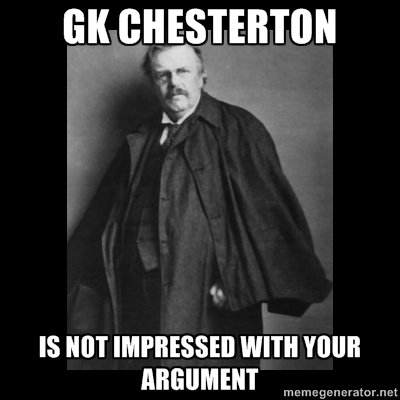
It was the best one I could find of him on Catholic Memes.
Perhaps I should say a word about Orthodoxy, since it ties in with the quest for truth them that I have been nattering about on this post. Orthodoxy isn't a story about G. K. Chesterton; it's about his journey for, you guessed it, orthodoxy. He set out to find a religion that made sense to him, and found, when he outlined it, that it was Christianity. He just wanted truth, so he searched for it. And, as it was promised, he sought and found.
In Orthodoxy, he lays out his journey of discovery, and though it might seem ludicrously simple once you have grasped the fact he is making, it's really profound. Some of the simplest things are the most profound, really.
In Pace Christi,
Elyse
Tuesday, January 29, 2013
Semi-Official Post
Herein I will get my thoughts on past readings out of the way. If anyone's interested in reading them, by all means, do so for whatever sort of amusement you derive from them. If you are thinking along the same lines as me, however, I can only express my deepest sympathy. My mind is a strange place.
Up at bat first is Diderot's Supplement to the Voyage of Bougainvile. It's remarkable how my human geography, history, and literature classes overlap. We talk about ethnocentrism and European misconceptions concerning the Indies in human geography, and then we have a reading on that sort of topic in literature. Dr. Brewton talks today about the Spartans flinging non-Spartan-ideal babies off cliffs, and guess what Dr. Makowski was talking about the other day.
I have a confession to make, though. No, I did the reading. It's not that. It's the name Bougainville. I can't get over it. I'm a German person who finds French bewildering/incomprehensible/hysterically nonsensical, take your pick, so I take one look at 'Bougainville' and start laughing. It just had no dignity left once I saw the pronunciation and mentally connected it with 'boogers'. (I have two younger brothers. These things happen.) And so I was reading about the voyages of Boogerville.
Sorry. I'm trying not to snicker audibly as I type this.
Anyway, I think Diderot set up a strawman argument in hiw whole story about Orou and the Almoner. I'm not sure how serious Diderot was with the whole thing, but the way he gave such an elevated diction and an eloquent manner of articulating his ideas to Orou, who is supposed to be nothing more than an uneducated islander, seems to me to indicate that the whole is a bit of an Author Tract. The Almoner barely presents an argument in his own defense and caves in to the girl. Orou goes on and on in a Wall of Text about his 'natural law' (which isn't much like the definition of natural law I know).
It certainly seems to me that Diderot has fallen prey to the idea of the 'Noble Savage', possibly influenced by Rosseau, who believed that people are naturally good and if left to their own devices, away from the corrupting influences of society, religion, etc., will do good things. This is in contrast to philosophers such as Hobbes and Schopenhauer, who believed people are irredeemably wicked.
This is why I love Christianity. It doesn't just settle for a lukewarm medium, it takes both and runs with it, achieving the crazy balance described in G. K. Chesterton's Orthodoxy. Christianity believes that people are very good creations that have been terribly warped. We will more easily do bad things than we will ever do good things.
It reminds me of a line from the Narn i Hin Hurin, 'The Tale of the Children of Hurin', by J. R. R. Tolkien, where the old lame guy (whose name I cannot recall at the moment, thought I want to say it began with an s) tells Turin, "They have learned far more quickly from the orcs than we have learned from the elves."
It's sad, isn't it? But it's true. Clothing it in sweet words does not help any matters, as Soren says in Fire Emblem: Path of Radiance. However, at least I haven't lost all faith in people. I don't have unshakeable optimism, though.
I'd also like to add to what I touched on in my previous post about the quest for home. I think the quest theme is so prevalent in world literature since the beginning of time since we are all on little quests of our own. We are all searching for a meaning and a purpose to our lives and to all life in general. Also, we are searching for our home, a home that we miss without knowing clearly why or how- our very own Paradise Lost, our original state of innocence that we have lost and which we cannot fully regain on our own.
And we go on searching, nevertheless, even in the worst places of society. We search for meaning and completeness in drugs, in alcohol, in various other vices, and yet we never find it there. You cannot gain happiness by seeking it directly. If you do, it eludes your grasp and turns into the deepest bitterness and unhappiness. If you forget yourself, however, and aim for the good, then happiness will be added unto you...
Oh, and I have to add this about the Basho stuff. This is all I know of Zen Buddhism, and (any actual Buddhists out there are probably actually rolling in their graves):
"There is a knocking without!"
"A knocking without what?"
"A knocking without the door, stupid!"
"A knocking without a door? Is this some kind of Zen?"
It's from Wyrd Sisters, by Terry Pratchett. The quote continues, but I can't remember the rest and can't seem to find it on the Internet at the moment, either...
Today, however, we covered Gulliver's Travels. I find it amusing that Gulliver's first name is 'Lemuel', because, as far as I can remember, it is King LemENuel who is referenced in the Bible. (Knowing about 17th and 18th century Protestants' love of giving Old Testament names to their children).
Anyway, you may dissect the levels of satire in Jonathan Swift's works all you like, but I still don't care for him. I do believe he was misanthropic, and I submit as my evidence this quote in the book itself, page 231: "But principally I hate and detest that animal called man, although I heartily love John, Peter, Thomas, and so forth."
I find it curious that he loves individuals but hates the race. The race is an abstract concept, which would seem easier to love than individuals. At least, I see it that way. The exact opposite of Swift is Dr. Weston from Out of the Silent Planet, by C. S. Lewis. Weston has lost all the rules of natural law except one, the love of his race. As the Oyarsa (angelic ruler) of Malacandra (Mars) points out, that one rule has been exalted in Weston's mind to the detriment and loss of everything else, becoming "a little blind Oyarsa" ordering Weston to do insane things for the propagation of mankind across the stars.
It's a good thing Ransom stopped him. I like Ransom, at least in Out of the Silent Planet and Perelandra. (I don't know what happened in between Perelandra and That Hideous Strength, but I don't advocate reading the latter. I just don't. It's bewildering and not even interesting, save for one good chapter, 'The Descent of the Gods', and the bit where the villains get killed in various horrible ways.) I like Ransom's name- Elwin Ransom. The fact that a lot of people think he was based off of J. R. R. Tolkien doesn't hurt (and I subscribe to this theory myself).
Well. I think I have the majority of my thoughts out of the way, in no cohesive or logical order. Anyway. Apologies for rambling.
In Pace Christi,
Elyse
Up at bat first is Diderot's Supplement to the Voyage of Bougainvile. It's remarkable how my human geography, history, and literature classes overlap. We talk about ethnocentrism and European misconceptions concerning the Indies in human geography, and then we have a reading on that sort of topic in literature. Dr. Brewton talks today about the Spartans flinging non-Spartan-ideal babies off cliffs, and guess what Dr. Makowski was talking about the other day.
I have a confession to make, though. No, I did the reading. It's not that. It's the name Bougainville. I can't get over it. I'm a German person who finds French bewildering/incomprehensible/hysterically nonsensical, take your pick, so I take one look at 'Bougainville' and start laughing. It just had no dignity left once I saw the pronunciation and mentally connected it with 'boogers'. (I have two younger brothers. These things happen.) And so I was reading about the voyages of Boogerville.
Sorry. I'm trying not to snicker audibly as I type this.
Anyway, I think Diderot set up a strawman argument in hiw whole story about Orou and the Almoner. I'm not sure how serious Diderot was with the whole thing, but the way he gave such an elevated diction and an eloquent manner of articulating his ideas to Orou, who is supposed to be nothing more than an uneducated islander, seems to me to indicate that the whole is a bit of an Author Tract. The Almoner barely presents an argument in his own defense and caves in to the girl. Orou goes on and on in a Wall of Text about his 'natural law' (which isn't much like the definition of natural law I know).
It certainly seems to me that Diderot has fallen prey to the idea of the 'Noble Savage', possibly influenced by Rosseau, who believed that people are naturally good and if left to their own devices, away from the corrupting influences of society, religion, etc., will do good things. This is in contrast to philosophers such as Hobbes and Schopenhauer, who believed people are irredeemably wicked.
This is why I love Christianity. It doesn't just settle for a lukewarm medium, it takes both and runs with it, achieving the crazy balance described in G. K. Chesterton's Orthodoxy. Christianity believes that people are very good creations that have been terribly warped. We will more easily do bad things than we will ever do good things.
It reminds me of a line from the Narn i Hin Hurin, 'The Tale of the Children of Hurin', by J. R. R. Tolkien, where the old lame guy (whose name I cannot recall at the moment, thought I want to say it began with an s) tells Turin, "They have learned far more quickly from the orcs than we have learned from the elves."
It's sad, isn't it? But it's true. Clothing it in sweet words does not help any matters, as Soren says in Fire Emblem: Path of Radiance. However, at least I haven't lost all faith in people. I don't have unshakeable optimism, though.
I'd also like to add to what I touched on in my previous post about the quest for home. I think the quest theme is so prevalent in world literature since the beginning of time since we are all on little quests of our own. We are all searching for a meaning and a purpose to our lives and to all life in general. Also, we are searching for our home, a home that we miss without knowing clearly why or how- our very own Paradise Lost, our original state of innocence that we have lost and which we cannot fully regain on our own.
And we go on searching, nevertheless, even in the worst places of society. We search for meaning and completeness in drugs, in alcohol, in various other vices, and yet we never find it there. You cannot gain happiness by seeking it directly. If you do, it eludes your grasp and turns into the deepest bitterness and unhappiness. If you forget yourself, however, and aim for the good, then happiness will be added unto you...
Oh, and I have to add this about the Basho stuff. This is all I know of Zen Buddhism, and (any actual Buddhists out there are probably actually rolling in their graves):
"There is a knocking without!"
"A knocking without what?"
"A knocking without the door, stupid!"
"A knocking without a door? Is this some kind of Zen?"
It's from Wyrd Sisters, by Terry Pratchett. The quote continues, but I can't remember the rest and can't seem to find it on the Internet at the moment, either...
Today, however, we covered Gulliver's Travels. I find it amusing that Gulliver's first name is 'Lemuel', because, as far as I can remember, it is King LemENuel who is referenced in the Bible. (Knowing about 17th and 18th century Protestants' love of giving Old Testament names to their children).
Anyway, you may dissect the levels of satire in Jonathan Swift's works all you like, but I still don't care for him. I do believe he was misanthropic, and I submit as my evidence this quote in the book itself, page 231: "But principally I hate and detest that animal called man, although I heartily love John, Peter, Thomas, and so forth."
I find it curious that he loves individuals but hates the race. The race is an abstract concept, which would seem easier to love than individuals. At least, I see it that way. The exact opposite of Swift is Dr. Weston from Out of the Silent Planet, by C. S. Lewis. Weston has lost all the rules of natural law except one, the love of his race. As the Oyarsa (angelic ruler) of Malacandra (Mars) points out, that one rule has been exalted in Weston's mind to the detriment and loss of everything else, becoming "a little blind Oyarsa" ordering Weston to do insane things for the propagation of mankind across the stars.
It's a good thing Ransom stopped him. I like Ransom, at least in Out of the Silent Planet and Perelandra. (I don't know what happened in between Perelandra and That Hideous Strength, but I don't advocate reading the latter. I just don't. It's bewildering and not even interesting, save for one good chapter, 'The Descent of the Gods', and the bit where the villains get killed in various horrible ways.) I like Ransom's name- Elwin Ransom. The fact that a lot of people think he was based off of J. R. R. Tolkien doesn't hurt (and I subscribe to this theory myself).
Well. I think I have the majority of my thoughts out of the way, in no cohesive or logical order. Anyway. Apologies for rambling.
In Pace Christi,
Elyse
Tuesday, January 22, 2013
1st Official Blog Post
According to what I learned in my speech class last semester, a speaker should never end a speech with an apology (e.g., for not having enough time to say everything, for not giving a good speech, and so forth). However, I think it is perfectly permissible to still start a speech (or a blog post) with an apology for its quality, or lack thereof.
Therefore, I am apologizing for the quality, or rather the lack thereof, in this blog post. I'm not really sure what exactly this post should be like, so I am going to try one thing and see if it works. If not... well, at the very least I shall attempt to curb some of my random tangents.
Well.
So far in literature, we have covered The Nutcracker, by E. T. A. Hoffman, The Gift of the Magi, by O. Henry, and some selections from Pu-Song Ling (a Chinese guy) and Basho (the penname of a Japanese guy).
I must confess that I didn't get much out of the latter two authors. The fable by Ling wasn't hard to understand, but let's just say stories involving lust make me cringe and move on. Let Us Never Speak Of This Again. As for the poetry (mainly haikus) and prose by Basho... hmm... I agree with Dr. Brewton. I found the simple elegance of the prose a lot more involving than the haikus. I just don't understand poetry at the best of times (unless it tells a story, and then I may like it), and haikus wrack my poor brain.
It also doesn't help that whenever I think of haikus my brain jumps to The Titan's Curse by Rick Riordan- third in the Percy Jackson series- where Apollo keeps spouting off horrible haikus. (They go something like this: "Sun breaks through the clouds/ Artemis pleads for my help/ I am so awesome.") And then I think of the funny line: "Let's go see if we roasted anyone important," and I am officially no longer concentrating.
I did try!
Now that my very extended apology is over, I shall forge ahead into the body of my blog post. (Blog posts aren't too much like letters, but I think some similarities should exist.)
The theme that struck me the most through our various reading selections so far was the theme of a quest, of going on a life-changing search for something or someone. In The Nutcracker, the astrologer and the clock-maker (a.k.a. Drosselmeier) go on a search for the special golden nut and the special boy who hasn't shaved or worn boots to crack it and offer it to the disfigured princess in a suitably dramatic fashion. The question of how the astrologer is able to learn all that from studying the stars aside, the end result is the two go on a quest through many foreign countries and cities. Ironically, they find both the boy and the nut in a city close to home (Leipzig springs to mind, but I could be wrong).
As I admitted in my normal blog, reading The Nutcracker reminded me greatly of the anime Princess Tutu. This was primarily because there was also a character named Drosselmeyer who told stories, even if PT's Drosselmeyer was far more sinister. PT also involved a quest. Duck (the main character, who transforms into the eponymous Princess Tutu) is on a quest to find all the heart shards lost by Prince Mytho so his feelings will be restored. As the anime goes on, finding the shards involves greater and greater effort, until at the end Duck must give up everything, becoming just an ordinary duck once more instead of a human girl, in order to complete her quest and free the prince from his nigh-soulless existence.
(Dr. Brewton said to make our blog interactive. Therefore, I am posting this video again, in hopes that I will convert someone to Princess Tutu.)
To continue with the theme of going on a quest, there is also my latest fixation: The Hobbit: An Unexpected Journey. If you know anything at all about the movie or the book, you know that the 13 Dwarves in The Hobbit are on a quest to their lost homeland of Erebor (a.k.a the Lonely Mountain), which was invaded and taken from them by the malicious dragon, Smaug. In the book, the Dwarves seem more concerned with getting their gold back, while in the movie their desire to have their home back is emphasized more. I like the change, since it makes the Dwarves more relatable. Also, it emphasizes the fact that in Dwarf culture they value their homelands (Moria, Erebor) in ways that non-Dwarves find hard to empathize with.
It isn't the Dwarves' fault that returning to their homelands tends to involve waking up nasty beasties that would have been better left asleep...
Ironically, The Lord of the Rings is not a quest in the true sense. The Fellowship does not set out to find some object that will save Middle-earth. Instead, they have set out to destroy the Ring, and thereby save Middle-earth. It is almost an anti-quest.
The quest theme was not so prevalent in The Gift of the Magi, however. One could say that Della is questing for a suitable gift for Jim, and the story details her sacrifices in order to attain the end result of her quest. Off-screen, Jim has a quest to find a gift for Della, and also sacrifices his most valued possession in order to get one for her.
However, quests can go awry. In Ling's story The Mural, Chu falls in love with a painting and somehow gets sucked into it. (We're a Genre Savvy class. We knew the instant it said Chu lost his self-control that bad things would happen.) He is on a twisted sort of a quest himself, in order to get the maiden from the painting, but since the object of his quest is a selfish desire, the quest itself and also its end result end only in fear, frustration, and suffering for him.
Lesson, class: quests are bad when their objects are bad, and when the method of questing is bad.
The travel narrative of Basho was also a quest of a sort, however, and a much less selfish one, related to the self though it may be. According to my limited understanding of Buddhism (I have never clearly understood what exactly meditation is supposed to be), he is going on a quest for enlightenment, wherein he can lose his desires and self-consciousness in the emotion of the moment. This 'moment' can come about from various instances of beautiful scenary, national or religious landmarks, and various other inspirations. Since his method of questing is good and his desire to lose himself is good, his quest is good.
You might even say that he had one of the noblest quests of all, since he was searching for self-sanctification.
I wanted to say that his losing himself in the moment might be an example of ek-stasis, a 'standing outside of yourself', a Greek term that has led to our modern word 'ecstasy'. However, most of the class might have connoted that with a type of drug- not the connotation I wanted at all- and I would have had to explain Greek and a good deal of philosophy behind it. Did not feel like regurgitating several books' worth of Peter Kreeft, so I kept my mouth shut.
That's why I have this blog, after all.
I find it interesting that the theme of a quest speaks so strongly to me. What is, after all, the most moving form of a quest? The quest to right a wrong... to return what has been stolen (a.k.a., the Arkenstone)... to reclaim a long-lost homeland.
Reclaiming a homeland. Isn't that what we are all trying to do? We're all looking for our little Paradises Lost. Paradise Losts? Scratch that. We're all looking for Paradise Lost. Mankind has lost the innocence and the freedom he once enjoyed, and yet he still seeks for it everywhere on this side of the Angel of Death, though he will not find it here.
He is still seeking. He is still like the Magi, mentioned at the end of O. Henry's story, questing across the world, priceless gifts in their hands, searching for the King of Kings. Man searches, often in the most unlikely of places, and he who seeks honestly will find. It was promised so.
Do I often get this philosophical about literature? Um, yeah. Make me talk about a theme, and sooner or later I'm off into my Lebensschauung and my Weltansschauung. And dissecting exactly how and why the literature I just read did not (or, rarely, how it did) line up with said views and beliefs of mine.
I'm at once a nice critic and a harsh critic of literature. I'm willing to accept plenty of things. It's just I don't take stupidity very well.
I'm going to have a hard time in life.
And this is the moment where I break the rule I learned in speech and apologize at the end of this blog post. (I almost typed 'plog bost', XD.) I have tried my best at addressing all of our reading selections so far with a unifying theme, but it is not up to me to decide if I succeeded or not.
I tried. Do I get a gold star?
In Pace Christi,
Elyse
Therefore, I am apologizing for the quality, or rather the lack thereof, in this blog post. I'm not really sure what exactly this post should be like, so I am going to try one thing and see if it works. If not... well, at the very least I shall attempt to curb some of my random tangents.
Well.
So far in literature, we have covered The Nutcracker, by E. T. A. Hoffman, The Gift of the Magi, by O. Henry, and some selections from Pu-Song Ling (a Chinese guy) and Basho (the penname of a Japanese guy).
I must confess that I didn't get much out of the latter two authors. The fable by Ling wasn't hard to understand, but let's just say stories involving lust make me cringe and move on. Let Us Never Speak Of This Again. As for the poetry (mainly haikus) and prose by Basho... hmm... I agree with Dr. Brewton. I found the simple elegance of the prose a lot more involving than the haikus. I just don't understand poetry at the best of times (unless it tells a story, and then I may like it), and haikus wrack my poor brain.
It also doesn't help that whenever I think of haikus my brain jumps to The Titan's Curse by Rick Riordan- third in the Percy Jackson series- where Apollo keeps spouting off horrible haikus. (They go something like this: "Sun breaks through the clouds/ Artemis pleads for my help/ I am so awesome.") And then I think of the funny line: "Let's go see if we roasted anyone important," and I am officially no longer concentrating.
I did try!
Now that my very extended apology is over, I shall forge ahead into the body of my blog post. (Blog posts aren't too much like letters, but I think some similarities should exist.)
The theme that struck me the most through our various reading selections so far was the theme of a quest, of going on a life-changing search for something or someone. In The Nutcracker, the astrologer and the clock-maker (a.k.a. Drosselmeier) go on a search for the special golden nut and the special boy who hasn't shaved or worn boots to crack it and offer it to the disfigured princess in a suitably dramatic fashion. The question of how the astrologer is able to learn all that from studying the stars aside, the end result is the two go on a quest through many foreign countries and cities. Ironically, they find both the boy and the nut in a city close to home (Leipzig springs to mind, but I could be wrong).
As I admitted in my normal blog, reading The Nutcracker reminded me greatly of the anime Princess Tutu. This was primarily because there was also a character named Drosselmeyer who told stories, even if PT's Drosselmeyer was far more sinister. PT also involved a quest. Duck (the main character, who transforms into the eponymous Princess Tutu) is on a quest to find all the heart shards lost by Prince Mytho so his feelings will be restored. As the anime goes on, finding the shards involves greater and greater effort, until at the end Duck must give up everything, becoming just an ordinary duck once more instead of a human girl, in order to complete her quest and free the prince from his nigh-soulless existence.
(Dr. Brewton said to make our blog interactive. Therefore, I am posting this video again, in hopes that I will convert someone to Princess Tutu.)
To continue with the theme of going on a quest, there is also my latest fixation: The Hobbit: An Unexpected Journey. If you know anything at all about the movie or the book, you know that the 13 Dwarves in The Hobbit are on a quest to their lost homeland of Erebor (a.k.a the Lonely Mountain), which was invaded and taken from them by the malicious dragon, Smaug. In the book, the Dwarves seem more concerned with getting their gold back, while in the movie their desire to have their home back is emphasized more. I like the change, since it makes the Dwarves more relatable. Also, it emphasizes the fact that in Dwarf culture they value their homelands (Moria, Erebor) in ways that non-Dwarves find hard to empathize with.
It isn't the Dwarves' fault that returning to their homelands tends to involve waking up nasty beasties that would have been better left asleep...
Ironically, The Lord of the Rings is not a quest in the true sense. The Fellowship does not set out to find some object that will save Middle-earth. Instead, they have set out to destroy the Ring, and thereby save Middle-earth. It is almost an anti-quest.
The quest theme was not so prevalent in The Gift of the Magi, however. One could say that Della is questing for a suitable gift for Jim, and the story details her sacrifices in order to attain the end result of her quest. Off-screen, Jim has a quest to find a gift for Della, and also sacrifices his most valued possession in order to get one for her.
However, quests can go awry. In Ling's story The Mural, Chu falls in love with a painting and somehow gets sucked into it. (We're a Genre Savvy class. We knew the instant it said Chu lost his self-control that bad things would happen.) He is on a twisted sort of a quest himself, in order to get the maiden from the painting, but since the object of his quest is a selfish desire, the quest itself and also its end result end only in fear, frustration, and suffering for him.
Lesson, class: quests are bad when their objects are bad, and when the method of questing is bad.
The travel narrative of Basho was also a quest of a sort, however, and a much less selfish one, related to the self though it may be. According to my limited understanding of Buddhism (I have never clearly understood what exactly meditation is supposed to be), he is going on a quest for enlightenment, wherein he can lose his desires and self-consciousness in the emotion of the moment. This 'moment' can come about from various instances of beautiful scenary, national or religious landmarks, and various other inspirations. Since his method of questing is good and his desire to lose himself is good, his quest is good.
You might even say that he had one of the noblest quests of all, since he was searching for self-sanctification.
I wanted to say that his losing himself in the moment might be an example of ek-stasis, a 'standing outside of yourself', a Greek term that has led to our modern word 'ecstasy'. However, most of the class might have connoted that with a type of drug- not the connotation I wanted at all- and I would have had to explain Greek and a good deal of philosophy behind it. Did not feel like regurgitating several books' worth of Peter Kreeft, so I kept my mouth shut.
That's why I have this blog, after all.
I find it interesting that the theme of a quest speaks so strongly to me. What is, after all, the most moving form of a quest? The quest to right a wrong... to return what has been stolen (a.k.a., the Arkenstone)... to reclaim a long-lost homeland.
Reclaiming a homeland. Isn't that what we are all trying to do? We're all looking for our little Paradises Lost. Paradise Losts? Scratch that. We're all looking for Paradise Lost. Mankind has lost the innocence and the freedom he once enjoyed, and yet he still seeks for it everywhere on this side of the Angel of Death, though he will not find it here.
He is still seeking. He is still like the Magi, mentioned at the end of O. Henry's story, questing across the world, priceless gifts in their hands, searching for the King of Kings. Man searches, often in the most unlikely of places, and he who seeks honestly will find. It was promised so.
Do I often get this philosophical about literature? Um, yeah. Make me talk about a theme, and sooner or later I'm off into my Lebensschauung and my Weltansschauung. And dissecting exactly how and why the literature I just read did not (or, rarely, how it did) line up with said views and beliefs of mine.
I'm at once a nice critic and a harsh critic of literature. I'm willing to accept plenty of things. It's just I don't take stupidity very well.
I'm going to have a hard time in life.
And this is the moment where I break the rule I learned in speech and apologize at the end of this blog post. (I almost typed 'plog bost', XD.) I have tried my best at addressing all of our reading selections so far with a unifying theme, but it is not up to me to decide if I succeeded or not.
I tried. Do I get a gold star?
In Pace Christi,
Elyse
Thursday, January 10, 2013
I Just Don't Get It

WHY WILL BLOGGER LET ME PUT PICTURES ON THIS BLOG, BUT NOT ON MY NORMAL ONE????
I SHALL KILL GOOGLE! I SWEAR! I SHALL KILL IT!
...Oh, and by the way, that is a fanart (not mine) of Thorin with young Fili and Kili. And that's Bofur with the amazing hat.
I want his hat.
I will steal his hat.
After I kill Google.
In Pace Christi,
Elyse
Sooooooo. Second Blog.
HEY, WORLD, HERE I AM!!
...What? Dr. Brewton said to post something along those lines.
The other thing I should answer is what you are probably thinking, "What the heck did she name her blog?"
Well, I felt the need to get nerdy and turned to German. Therefore, the name of my blog is Der Schreibblock Einer Leseratte, which translated means, "The Writing Tablet of a Bookworm." So there you go. It's apt enough, I think.
The question is... will it let me post pictures now???
So I am going to send Dr. Brewton a link to this, and it will go on the syllabus. It would make me very happy if it got the top of the list, but someone's probably already got it by now. Oh, well.
Peoples! If you are just now stumbling across this blog and wondering exactly what kind of a nutcase am I (and if you are brave enough to try to find out), my other blog is Clueless Freshman. Reading it will explain perfectly what kind of person I am. Yes, it was my freshman honors blog, which I kept for my sophomore year with a disclaimer under the title.
It's all Dr. Brewton's fault! I was told to keep a blog and now I love blogging and I can't stop!
So I will probably have NO PROBLEM with the blogging aspect of this literature course.
In Pace Christi,
Elyse
P. S. I always sign off that way, for you newbies. It means, 'In the Peace of Christ.' It's Latin. I love Latin. I will take any excuse to work Latin and German into my life.
...What? Dr. Brewton said to post something along those lines.
The other thing I should answer is what you are probably thinking, "What the heck did she name her blog?"
Well, I felt the need to get nerdy and turned to German. Therefore, the name of my blog is Der Schreibblock Einer Leseratte, which translated means, "The Writing Tablet of a Bookworm." So there you go. It's apt enough, I think.
The question is... will it let me post pictures now???
So I am going to send Dr. Brewton a link to this, and it will go on the syllabus. It would make me very happy if it got the top of the list, but someone's probably already got it by now. Oh, well.
Peoples! If you are just now stumbling across this blog and wondering exactly what kind of a nutcase am I (and if you are brave enough to try to find out), my other blog is Clueless Freshman. Reading it will explain perfectly what kind of person I am. Yes, it was my freshman honors blog, which I kept for my sophomore year with a disclaimer under the title.
It's all Dr. Brewton's fault! I was told to keep a blog and now I love blogging and I can't stop!
So I will probably have NO PROBLEM with the blogging aspect of this literature course.
In Pace Christi,
Elyse
P. S. I always sign off that way, for you newbies. It means, 'In the Peace of Christ.' It's Latin. I love Latin. I will take any excuse to work Latin and German into my life.
Subscribe to:
Posts (Atom)